











See Deepening and Stronger Ties between Hainan and ASEAN
HICN2026-11-26 09:34:14
The "Hainan on the Rise" column of China Report ASEAN published its second and third special reports on the Hainan Free Trade Port, focusing on the deepening ties and stronger regional connectivity between the island province in Southern China and ASEAN.
Below are the front page as well as the full text of the reports:
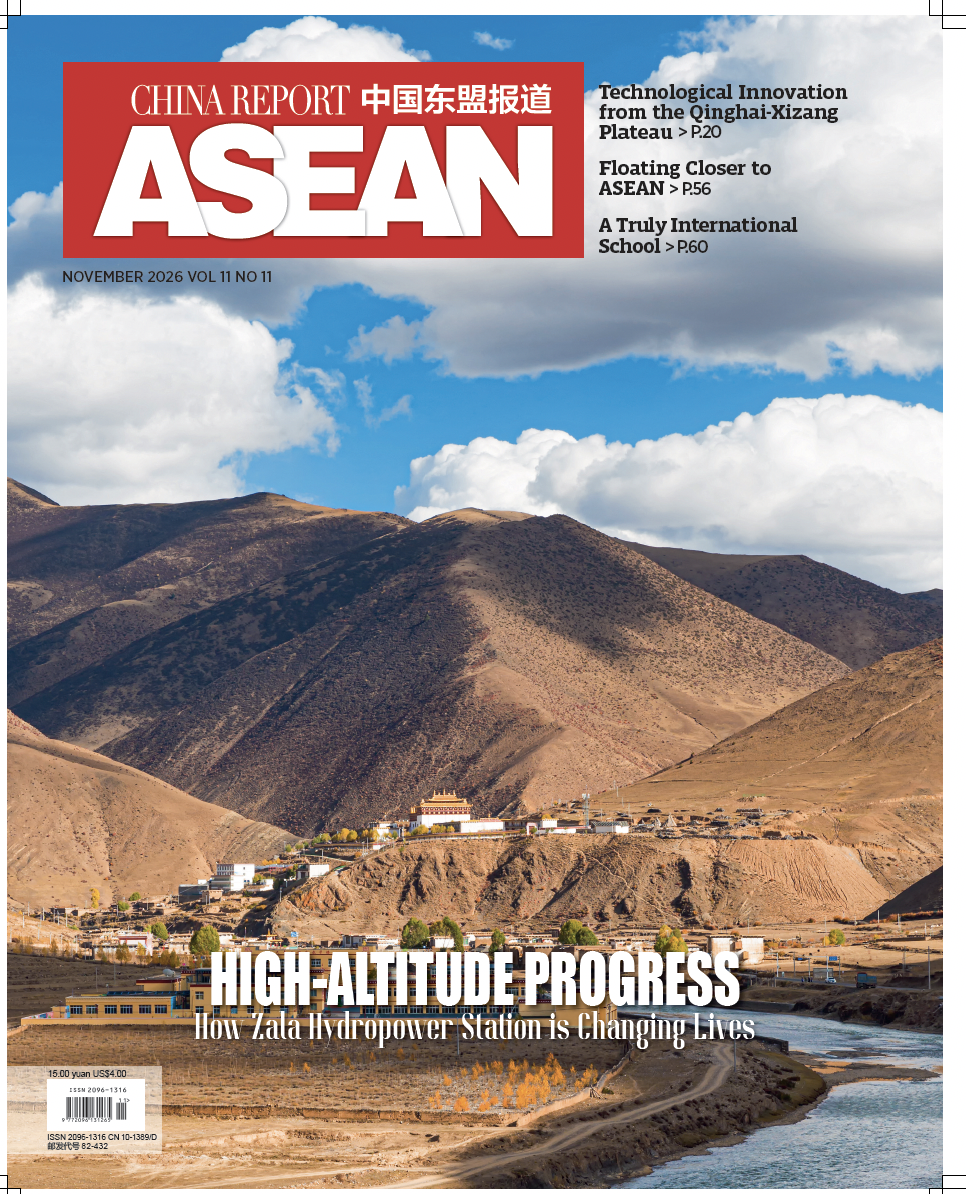
Magazine cover
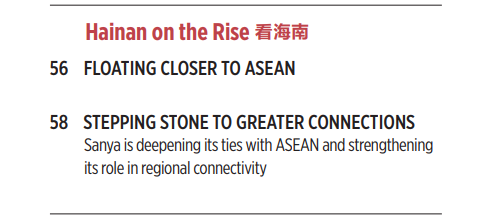
Table of contents
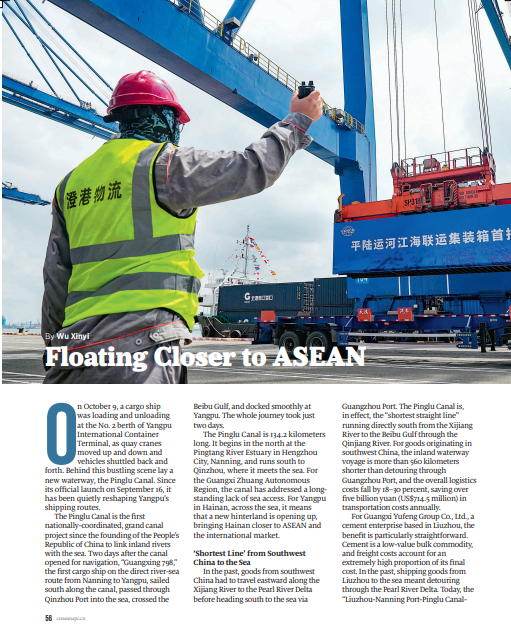
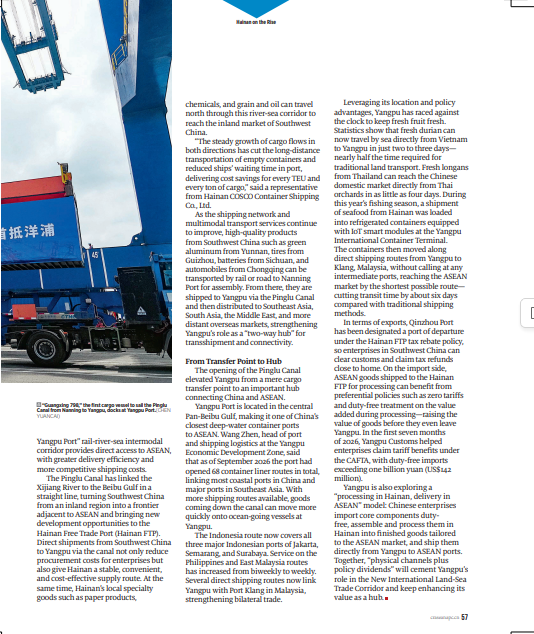
Full Text of "Floating Closer to ASEAN"
On October 9, a cargo ship was loading and unloading at the No. 2 berth of Yangpu International Container Terminal, as quay cranes moved up and down and vehicles shuttled back and forth. Behind this bustling scene lay a new waterway, the Pinglu Canal. Since its official launch on September 16, it has been quietly reshaping Yangpu’s shipping routes.
The Pinglu Canal is the first nationally-coordinated, grand canal project since the founding of the People’s Republic of China to link inland rivers with the sea. Two days after the canal opened for navigation, “Guangxing 798,” the first cargo ship on the direct river-sea route from Nanning to Yangpu, sailed south along the canal, passed through Qinzhou Port into the sea, crossed the Beibu Gulf, and docked smoothly at Yangpu. The whole journey took just two days.
The Pinglu Canal is 134.2 kilometers long. It begins in the north at the Pingtang River Estuary in Hengzhou City, Nanning, and runs south to Qinzhou, where it meets the sea.
For the Guangxi Zhuang Autonomous Region, the canal has addressed a longstanding lack of sea access.
For Yangpu in Hainan, across the sea, it means that a new hinterland is opening up, bringing Hainan closer to ASEAN and the international market.
‘Shortest Line’ from Southwest China to the Sea
In the past, goods from southwest China had to travel eastward along the Xijiang River to the Pearl River Delta before heading south to the sea via Guangzhou Port. The Pinglu Canal is, in effect, the “shortest straight line” running directly south from the Xijiang River to the Beibu Gulf through the
Qinjiang River. For goods originating in southwest China, the inland waterway voyage is more than 560 kilometers shorter than detouring through Guangzhou Port, and the overall logistics costs fall by 18–30 percent, saving over five billion yuan (US$714.5 million) in transportation costs annually.
For Guangxi Yufeng Group Co., Ltd., a cement enterprise based in Liuzhou, the benefit is particularly straightforward.
Cement is a low-value bulk commodity, and freight costs account for an extremely high proportion of its final cost. In the past, shipping goods from Liuzhou to the sea meant detouring through the Pearl River Delta. Today, the “Liuzhou-Nanning Port-Pinglu Canal Yangpu Port” rail-river-sea intermodal
corridor provides direct access to ASEAN, with greater delivery efficiency and more competitive shipping costs.
The Pinglu Canal has linked the Xijiang River to the Beibu Gulf in a straight line, turning Southwest China from an inland region into a frontier adjacent to ASEAN and bringing new development opportunities to the Hainan Free Trade Port (Hainan FTP).
Direct shipments from Southwest China to Yangpu via the canal not only reduce procurement costs for enterprises but also give Hainan a stable, convenient, and cost-effective supply route. At the same time, Hainan’s local specialtygoods such as paper products, chemicals, and grain and oil can travel north through this river-sea corridor to reach the inland market of Southwest China.
“The steady growth of cargo flows in both directions has cut the long-distance transportation of empty containers and reduced ships’ waiting time in port, delivering cost savings for every TEU and every ton of cargo,” said a representative from Hainan COSCO Container Shipping Co., Ltd.
As the shipping network and multimodal transport services continue to improve, high-quality products from Southwest China such as green aluminum from Yunnan, tires from Guizhou, batteries from Sichuan, and automobiles from Chongqing can be transported by rail or road to Nanning Port for assembly.
From there, they are shipped to Yangpu via the Pinglu Canal and then distributed to Southeast Asia, South Asia, the Middle East, and more distant overseas markets, strengthening Yangpu’s role as a “two-way hub” for transshipment and connectivity.
From Transfer Point to Hub
The opening of the Pinglu Canal elevated Yangpu from a mere cargo transfer point to an important hub connecting China and ASEAN.
Yangpu Port is located in the central Pan-Beibu Gulf, making it one of China’s closest deep-water container ports to ASEAN. Wang Zhen, head of port and shipping logistics at the Yangpu Economic Development Zone, said that as of September 2026 the port had opened 68 container liner routes in total, linking most coastal ports in China and major ports in Southeast Asia. With more shipping routes available, goods coming down the canal can move more quickly onto ocean-going vessels at Yangpu.
The Indonesia route now covers all three major Indonesian ports of Jakarta, Semarang, and Surabaya. Service on the Philippines and East Malaysia routes has increased from biweekly to weekly.
Several direct shipping routes now link Yangpu with Port Klang in Malaysia, strengthening bilateral trade. Leveraging its location and policy advantages, Yangpu has raced against the clock to keep fresh fruit fresh. Statistics show that fresh durian can now travel by sea directly from Vietnam to Yangpu in just two to three days— nearly half the time required for traditional land transport. Fresh longans from Thailand can reach the Chinese domestic market directly from Thai orchards in as little as four days. During this year’s fishing season, a shipment of seafood from Hainan was loaded into refrigerated containers equipped with IoT smart modules at the Yangpu International Container Terminal.
The containers then moved along direct shipping routes from Yangpu to Klang, Malaysia, without calling at any intermediate ports, reaching the ASEAN market by the shortest possible route— cutting transit time by about six days compared with traditional shipping methods.
In terms of exports, Qinzhou Port has been designated a port of departure under the Hainan FTP tax rebate policy, so enterprises in Southwest China can clear customs and claim tax refunds close to home.
On the import side, ASEAN goods shipped to the Hainan FTP for processing can benefit from preferential policies such as zero tariffs and duty-free treatment on the value added during processing—raising the value of goods before they even leave Yangpu.
In the first seven months of 2026, Yangpu Customs helped enterprises claim tariff benefits under the CAFTA, with duty-free imports exceeding one billion yuan (US$142 million).
Yangpu is also exploring a “processing in Hainan, delivery in ASEAN” model: Chinese enterprises import core components dutyfree, assemble and process them in Hainan into finished goods tailored to the ASEAN market, and ship them directly from Yangpu to ASEAN ports.
Together, “physical channels plus policy dividends” will cement Yangpu’s role in the New International Land-Sea Trade Corridor and keep enhancing its value as a hub.
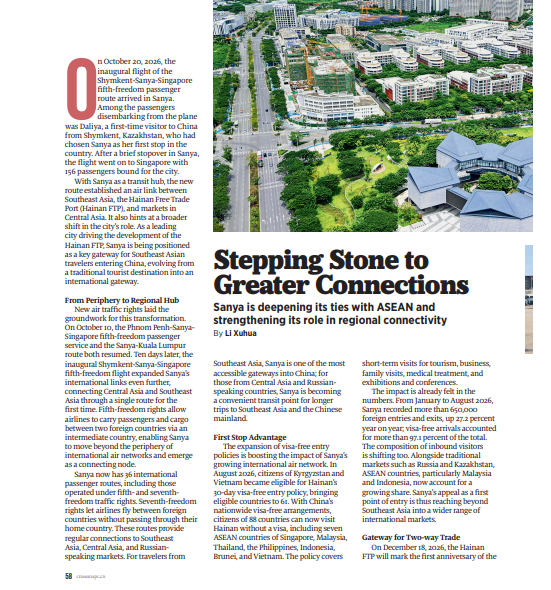
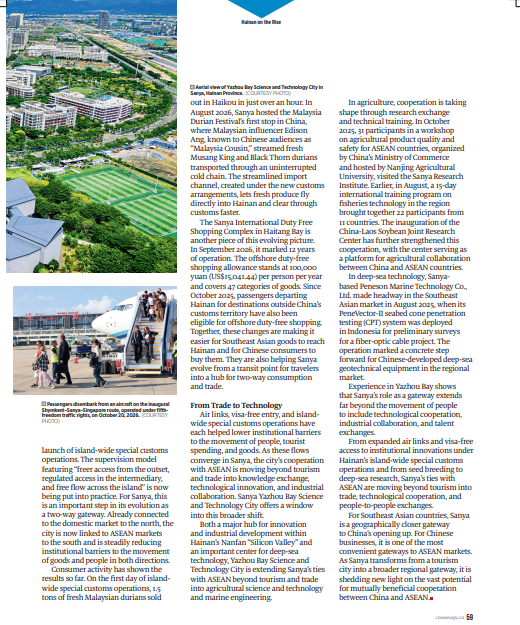
Full Text of "Stepping Stone to Greater Connections"
On October 20, 2026, the inaugural flight of the Shymkent-Sanya-Singapore fifth-freedom passenger route arrived in Sanya.
Among the passengers disembarking from the plane was Daliya, a first-time visitor to China from Shymkent, Kazakhstan, who had chosen Sanya as her first stop in the country. After a brief stopover in Sanya, the flight went on to Singapore with 156 passengers bound for the city.
With Sanya as a transit hub, the new route established an air link between Southeast Asia, the Hainan Free Trade Port (Hainan FTP), and markets in Central Asia. It also hints at a broader
shift in the city’s role. As a leading city driving the development of the Hainan FTP, Sanya is being positioned as a key gateway for Southeast Asian travelers entering China, evolving from a traditional tourist destination into an international gateway.
From Periphery to Regional Hub
New air traffic rights laid the groundwork for this transformation.
On October 10, the Phnom Penh-Sanya-Singapore fifth-freedom passenger service and the Sanya-Kuala Lumpur route both resumed. Ten days later, the inaugural Shymkent-Sanya-Singapore
fifth-freedom flight expanded Sanya’s international links even further, connecting Central Asia and Southeast Asia through a single route for the first time.
Fifth-freedom rights allow airlines to carry passengers and cargo between two foreign countries via an intermediate country, enabling Sanya to move beyond the periphery of international air networks and emerge as a connecting node.
Sanya now has 36 international passenger routes, including those operated under fifth- and seventh-freedom traffic rights.
Seventh-freedom rights let airlines fly between foreign countries without passing through their home country. These routes provide regular connections to Southeast Asia, Central Asia, and Russian-speaking markets. For travelers from Southeast Asia, Sanya is one of the most accessible gateways into China; for those from Central Asia and Russian-speaking countries, Sanya is becoming a convenient transit point for longer trips to Southeast Asia and the Chinese mainland.
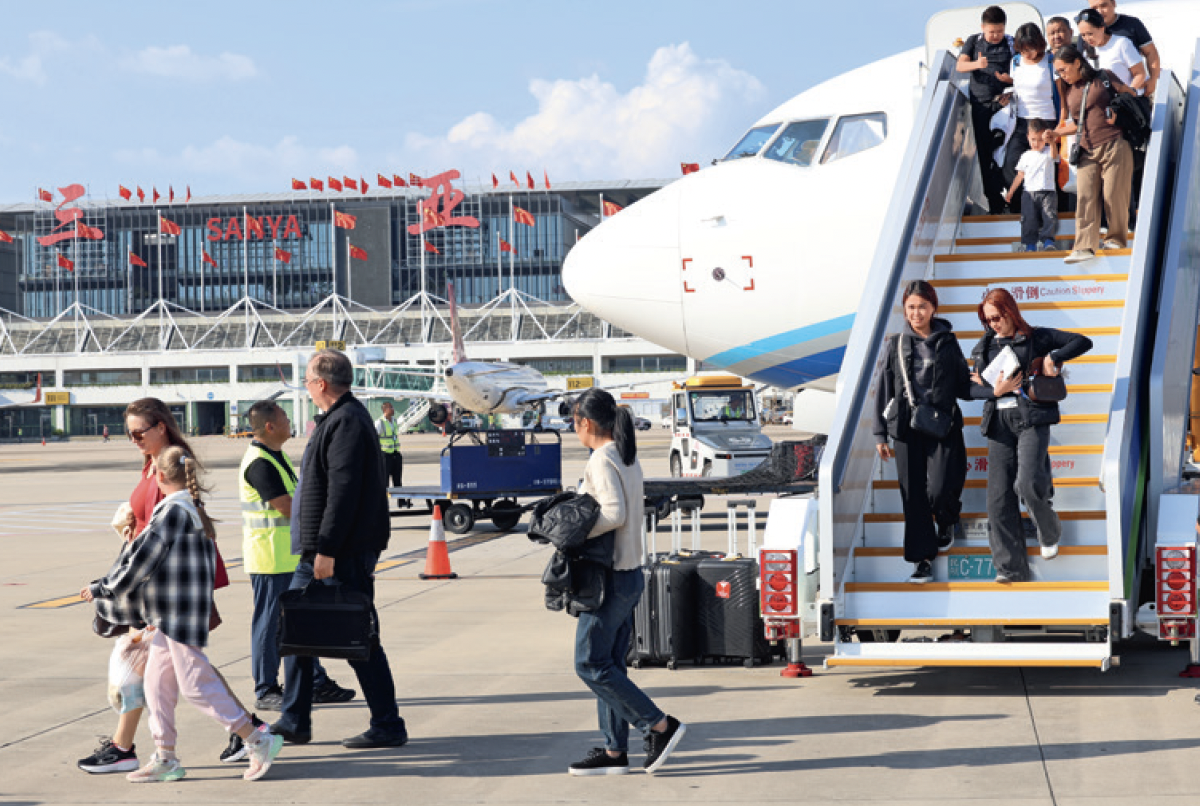
Passengers disembark from an aircraft on the inauguralShymkent–Sanya–Singapore route, operated under fifth-freedomtraffic rights, on October 20, 2026. (COURTESY PHOTO)
First Stop Advantage
The expansion of visa-free entry policies is boosting the impact of Sanya’s growing international air network.
In August 2026, citizens of Kyrgyzstan and Vietnam became eligible for Hainan’s 30-day visa-free entry policy, bringing eligible countries to 61. With China’s nationwide visa-free arrangements, citizens of 88 countries can now visit Hainan without a visa, including seven ASEAN countries of Singapore, Malaysia, Thailand, the Philippines, Indonesia, Brunei, and Vietnam.
The policy covers short-term visits for tourism, business, family visits, medical treatment, and exhibitions and conferences.
The impact is already felt in the numbers. From January to August 2026, Sanya recorded more than 650,000 foreign entries and exits, up 27.2 percent year on year; visa-free arrivals accounted for more than 97.1 percent of the total.
The composition of inbound visitors is shifting too. Alongside traditional markets such as Russia and Kazakhstan, ASEAN countries, particularly Malaysia and Indonesia, now account for a growing share. Sanya’s appeal as a first point of entry is thus reaching beyond Southeast Asia into a wider range of international markets.
Gateway for Two-way Trade
On December 18, 2026, the Hainan FTP will mark the first anniversary of the launch of island-wide special customs operations. The supervision model featuring “freer access from the outset, regulated access in the intermediary, and free flow across the island” is now being put into practice.
For Sanya, this is an important step in its evolution as a two-way gateway. Already connected to the domestic market to the north, the city is now linked to ASEAN markets to the south and is steadily reducing institutional barriers to the movement of goods and people in both directions.
Consumer activity has shown the results so far. On the first day of islandwide special customs operations, 1.5 tons of fresh Malaysian durians sold out in Haikou in just over an hour.
In August 2026, Sanya hosted the Malaysia Durian Festival’s first stop in China, where Malaysian influencer Edison Ang, known to Chinese audiences as “Malaysia Cousin,” streamed fresh Musang King and Black Thorn durians transported through an uninterrupted cold chain. The streamlined import channel, created under the new customs arrangements, lets fresh produce fly directly into Hainan and clear through customs faster.
The Sanya International Duty Free Shopping Complex in Haitang Bay is another piece of this evolving picture.
In September 2026, it marked 12 years of operation. The offshore duty-free shopping allowance stands at 100,000 yuan (US$15,041.44) per person per year and covers 47 categories of goods.
Since October 2025, passengers departing Hainan for destinations outside China’s customs territory have also been eligible for offshore duty-free shopping.
Together, these changes are making it easier for Southeast Asian goods to reach Hainan and for Chinese consumers to buy them. They are also helping Sanya evolve from a transit point for travelers into a hub for two-way consumption and trade.
From Trade to Technology
Air links, visa-free entry, and islandwide special customs operations have each helped lower institutional barriers to the movement of people, tourist spending, and goods. As these flows converge in Sanya, the city’s cooperation with ASEAN is moving beyond tourism and trade into knowledge exchange, technological innovation, and industrial collaboration. Sanya Yazhou Bay Science and Technology City offers a window into this broader shift.
Both a major hub for innovation and industrial development within Hainan’s Nanfan “Silicon Valley” and an important center for deep-sea technology, Yazhou Bay Science and Technology City is extending Sanya’s ties with ASEAN beyond tourism and trade into agricultural science and technology and marine engineering.
In agriculture, cooperation is taking shape through research exchange and technical training. In October 2025, 31 participants in a workshop on agricultural product quality and safety for ASEAN countries, organized by China’s Ministry of Commerce and hosted by Nanjing Agricultural University, visited the Sanya Research Institute.
Earlier, in August, a 15-day international training program on fisheries technology in the region
brought together 22 participants from 11 countries. The inauguration of the China-Laos Soybean Joint Research Center has further strengthened this cooperation, with the center serving as
a platform for agricultural collaboration between China and ASEAN countries.
In deep-sea technology, Sanyabased Peneson Marine Technology Co.,Ltd. made headway in the Southeast Asian market in August 2025, when its PeneVector-II seabed cone penetration
testing (CPT) system was deployed in Indonesia for preliminary surveys for a fiber-optic cable project. The operation marked a concrete step forward for Chinese-developed deep-sea geotechnical equipment in the regional market.
Experience in Yazhou Bay shows that Sanya’s role as a gateway extends far beyond the movement of people to include technological cooperation, industrial collaboration, and talent
exchanges.
From expanded air links and visa-free access to institutional innovations under Hainan’s island-wide special customs operations and from seed breeding to deep-sea research, Sanya’s ties with
ASEAN are moving beyond tourism into trade, technological cooperation, and people-to-people exchanges.
For Southeast Asian countries, Sanya is a geographically closer gateway to China’s opening up. For Chinese businesses, it is one of the most convenient gateways to ASEAN markets.
As Sanya transforms from a tourism city into a broader regional gateway, it is shedding new light on the vast potential for mutually beneficial cooperation between China and ASEAN.
作者: hicn
责任编辑: 魏君帆
南海网版权声明:以上内容由南海网原创生产,未经书面许可,任何单位及个人不得以任何方式或理由对上述内容的任何部分进行使用、复制、修改、抄录、传播或与其它产品捆绑使用、销售。如需转载,请与南海网联系授权,凡侵犯本公司版权等知识产权的,本公司必依法追究其法律责任。电子邮箱:nhwglzx@163.com.