











One Man's Quest to Revitalize an Endangered Species
HICN2026-11-12 20:47:40
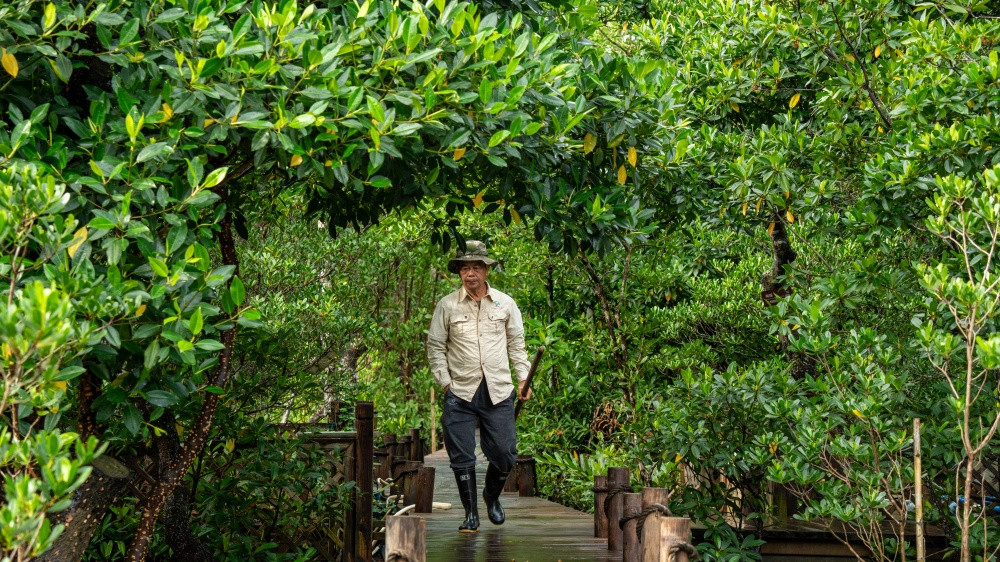
Wang Shijun begins his day at the Red Teruntum Nursery on November 4, 2026. (Source: Liu Sunmou)
Different cultures have different ways of marking time. For Wang Shijun, whose work depends on the ebb and flow of the tides, the lunar calendar matters more than the Gregorian calendar. On November 4, 2026, the 26th day of the ninth lunar month, he was once again at work in his nursery.
As a retired forestry worker, Wang has spent the past 13 years cultivating Red Teruntum (Lumnitzera littorea) at the Dongzhaigang National Nature Reserve in Haikou. Starting with a CNY 8,000 investment in 2013, he has helped bring this endangered mangrove species back from the brink. He has propagated and planted more than 4,000 seedlings, with some of the plants now in their fourth generation.
One of his greatest achievements has been reducing the time it takes Red Teruntum seeds to germinate from 54 days to just 16.
Now 70, Wang shows no signs of slowing down. Squatting in the muddy nursery, he carefully supports a seedling's roots as he removes it from its growing bag and lowers it into the ground.
"If I do this too quickly, the roots will break, and that could affect the plant's growth," he explains.
Despite his age, Wang moves with remarkable agility. He carries two saplings, each weighing more than 5 kilograms, one in each hand as he makes his way through the mud. After planting them, he secures each with two reused bamboo stakes and places a rubber ring around its base to keep small crabs from eating the roots.
His nursery covers nearly 8,000 square meters and is almost completely filled with plants. Only two or three square meters of open space remain.
"We have so many seedlings ready to plant. We can't leave the space empty," he says.
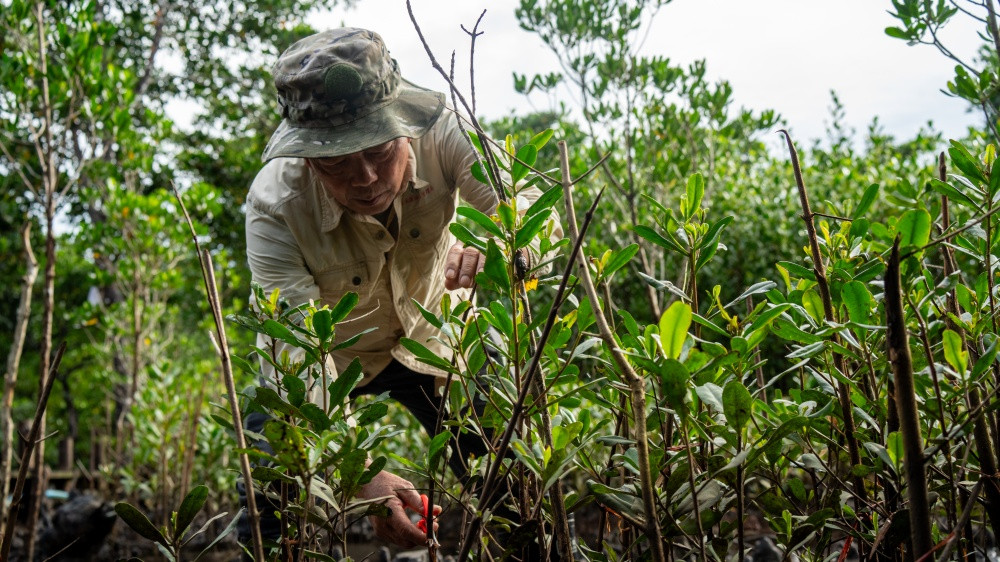
Wang Shijun at work in the Red Teruntum Nursery. (Source: Liu Sunmou)
A Small Investment, a Big Commitment
Wang first arrived at Dongzhaigang in 1980, aged 24, after discharging from the army. He was among the first employees of the Mangrove Protection Station and has devoted 46 years to mangrove conservation, including ten years of volunteer work since his retirement in 2016.
He first encountered Red Teruntum in the winter of 1981, during a survey of Hainan's mangrove forests. In December that year, he saw the species flowering in Dadun Village, Lingshui.
"December should have been the end of the flowering season, but the flowers were still dazzling red," he recalls.
Known as the "giant panda of mangroves," Red Teruntum is a nationally protected Class I plant species in China. A 2014 survey found only 14 wild plants remaining in the country, all in Hainan. They were so widely scattered that natural reproduction had become extremely difficult.
In 2013, at the age of 56 and just three years before retirement, Wang volunteered to take on the challenge.
"Give me three years. I'll find a way to propagate Red Teruntum," he told his colleagues.
With an initial budget of CNY 8,000, he began experimenting. He had no formal training in plant science, but managed to cultivate more than 200 seedlings in the early stages of his work.
The first time Nanguo Daily interviewed him about the project was on September 28, 2015. During the interview, Wang suddenly waved his hands and shouted, "It's going to rain! Run!"
The sky had been clear, with no sign of rain. Yet before the group had walked even 100 meters, a heavy downpour began. Wang had learned to read the weather through years of working in the nursery. A sudden storm could wash away months of work when the seedlings were still small.
That same year, his wife, Lin Ying, was diagnosed with breast cancer and hospitalized. His colleague Lin Huawen remembers that even while at his wife's bedside, Wang would frequently call to ask how the plants were doing.
At the end of 2015, Wang was named one of Hainan's Ten Most Moving People of the Year. He officially retired in 2016, but his routine barely changed. He continued going to the nursery every morning to water, fertilize and transplant seedlings.
More than a decade later, he remains active. The wrinkles on his face and calluses on his hands are reminders of the years he has spent working in the tidal flats.
The number of people coming to interview him has grown, too. In one year, as many as 25 groups of reporters visited Dongzhaigang to learn about his work.
He welcomes the attention.
"The more people hear about Red Teruntum, the better its chances of being protected," he says. But he has one request: "Don't just come here, say a few nice things and leave. Stuff like that is useless."
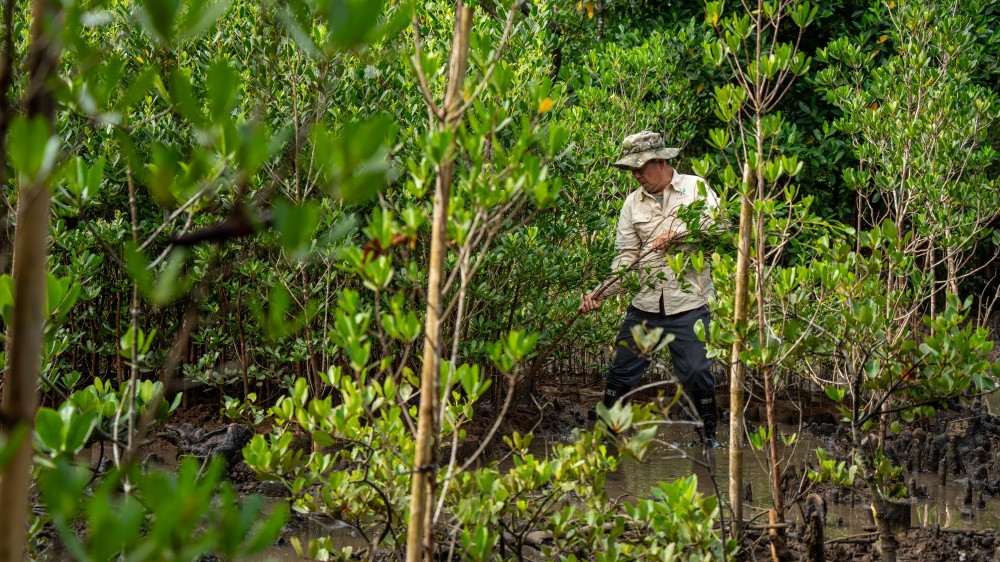
Wang Shijun at work in the Red Teruntum Nursery. (Source: Liu Sunmou)
A Hope for the Next Generation
Over the past 13 years, Wang's efforts have helped Red Teruntum grow from a handful of plants into a thriving grove. He estimates that he has propagated and planted more than 4,000 seedlings since 2013. In 2019 alone, he planted 720. Some of his seedlings have also been sent to universities and research institutions across China.
Years of working in the tidal flats have taught him how to protect the young plants. He uses rubber rings to keep small crabs from eating their roots and catches sea frogs at night. To improve airflow around the roots, he places perforated iron pipes beside the seedlings.
He does not, however, drive away larger crabs when they stir up the mud.
"When they loosen the soil, the roots can breathe, and the trees grow better," he explains.
His dedication has also inspired his daughter, Wang Xia, who works for the Dongzhaigang National Nature Reserve Management Office. She gives educational tours at the mangrove science museum and helps her father record the plants' growth.
"Dad has devoted his entire life to protecting the mangroves. Now it's my turn," she says.
For Wang, the motivation is simple. Learning that only 14 wild red teruntum plants remained in China came as a profound shock.
"I thought my country had the resources, talent and technology to protect its endangered species. If a species disappears from its own country, that just doesn't make sense."
When he first took on the challenge, Wang made a promise: "As long as I can still move, I'll keep doing this."
More than a decade later, he is still keeping that promise.
As the tide comes in, Wang checks the bamboo stakes supporting the two newest seedlings. Water begins to fill the lower parts of the nursery, but the young plants remain upright.
He hopes to live long enough to see Red Teruntum recover from the brink of extinction.
作者: Wang Dingbin
责任编辑: 王定斌
南海网版权声明:以上内容由南海网原创生产,未经书面许可,任何单位及个人不得以任何方式或理由对上述内容的任何部分进行使用、复制、修改、抄录、传播或与其它产品捆绑使用、销售。如需转载,请与南海网联系授权,凡侵犯本公司版权等知识产权的,本公司必依法追究其法律责任。电子邮箱:nhwglzx@163.com.