










Hainan Students Put Local Culture on Stage, Screen, and Beyond
HICN2026-10-21 18:09:09
The seventh National Ethnic Minority Arts Festival concluded at Beijing's Nationalities Theatre on the evening of September 23, 2026. At the closing ceremony, young dancers from Hainan University performed a piece inspired by Li Brocade—a traditional textile passed down through generations of Hainan's Li people. They used shifting formations and body movements to translate the traditional textile-making techniques of spinning, dyeing, weaving, and embroidery into dance.
Today, university students across Hainan are finding new ways to interpret local culture through different art forms, drawing on traditional crafts and historical figures while also producing short films about contemporary life and making cultural products inspired by the island's distinctive heritage.
Re-imagining Traditional Culture
Hainan University's Li Brocade-inspired dance piece took nearly a year to develop and choreograph. In the early stages, the creative team visited Li villages and met with recognized intangible cultural heritage representatives. They observed traditional spinning, dyeing, weaving, and embroidery firsthand, gathering video footage, textile patterns, and oral histories to inform their work.
Rather than using Li Brocade merely as stage decoration, the choreographers drew movement directly from the craft itself. The twisting of fingers while spinning yarn and the sweeping motions of arms during dyeing were refined and reworked into dance sequences. To illustrate the technique of creating identical patterns on both sides of the fabric, dancers faced one another in pairs and moved through mirrored formations, evoking needles passing through cloth and the matching designs emerging on either side.
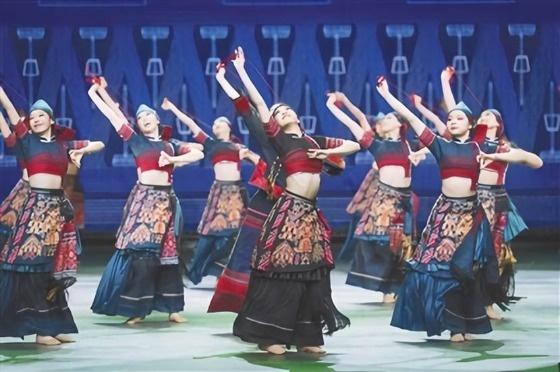
A dance piece created by Hainan University draws inspiration from Li Brocade techniques and the lives of the Li people. (Photo courtesy of Hainan University)
Hainan Vocational Institute of Art has turned to the island's history for inspiration. In July 2026, a dance piece exploring the relationship between Su Dongpo, a literary figure of China's Northern Song Dynasty (960–1127), and the people of Hainan received the "Qinghe Star" honor at the sixth Lotus Youth National Dance Showcase in Yinchuan, Ningxia.
Su Dongpo lived in exile in Hainan from 1097 to 1100. His experiences on the island and his interactions with local residents remain an important part of Hainan's historical and cultural heritage.
The dance portrays Su Dongpo's emotional farewell to the Li village residents when he was recalled north after his exile in Hainan. Huang Na, head of the institute's dance department and one of the choreographers, said the team drew on traditional Li dances, particularly those depicting everyday activities such as pounding rice and gathering firewood. They adapted movements characterized by lowered stances, sharp rhythmic accents, and rounded, flowing gestures, while incorporating the posture and rhythm of classical Chinese scholar's dances. After more than ten major revisions and dozens of smaller adjustments, the team developed a performance that brought the two cultural traditions together.
Huang believes that dance productions at Hainan's universities and colleges are gradually developing a distinctive identity. The subject matter increasingly draws on local history and folk traditions, while the aesthetics combine the openness and fluidity of maritime culture with the simplicity and depth of mountain culture. The dances are also placing greater emphasis on conveying emotion through individual characters and stories.
Finding Stories in Everyday Life
Beyond reinterpreting traditional culture, young artists at Hainan's universities are turning their attention to contemporary life, exploring how art and technology can work together to convey human emotions.
In April 2026, a short film produced by the Nanhai Academy of the Arts and Technology at the Haikou University of Economics won third prize in the arts category of the short-video competition at the 16th Beijing International Film Festival. The film had previously received an Outstanding New Literary and Artistic Work Award from China's National Radio and Television Administration.
The film tells the story of an elderly person living alone and a delivery worker. They make an arrangement: the courier will knock on the door each day to check that the elderly resident is safe. One day, sensing that something is wrong when there is no usual response, the courier stays instead of leaving, knocking repeatedly and trying to find out whether the resident is all right.
"Smart devices can monitor data, but they can't detect loneliness," said Jiang Tong, vice dean of the academy. She explained that the film uses the simple act of knocking on a door to explore the human care and connection that technology alone cannot provide. Bringing art and technology together, she said, requires an understanding not only of what technology can do but also of people's emotional needs, without allowing technical elements to overshadow the story itself.
To make the film, the students conducted field research in residential communities, elderly care facilities, and courier delivery stations. They discovered that, for some older people living alone, a delivery worker might be the only person they speak to all day.
Peng Na, director of the academy's Nanhai Art and Technology Training Center, believes filmmaking in Hainan should go beyond showcasing the island's scenery. The lives of people engaged in aquaculture and fishing, the traditions of the Tanka people who historically lived aboard boats and depended on the sea, and advances in deep-sea technology all offer material for storytelling. So do frontline workers involved in developing the Hainan Free Trade Port and newcomers who have moved to the island from elsewhere. The key, she said, is to engage closely with everyday life and explore these subjects through specific people and their stories.
Bringing Local Culture into More Art Forms
Alongside dance and film, music has become another important medium through which university students in Hainan are reinterpreting the island's cultural heritage.
In July 2024, Hainan Normal University’s Lanyun Choir traveled to Yuxi, Yunnan Province, for the Nie Er Cup National University Choir Showcase. Competing among 19 choirs from across China, the ensemble won first prize in the mixed-voice choir category, while the choir’s resident conductor, Li Ya, received an Outstanding Conductor Award.
For the performance, the choir drew on a Song-dynasty lyric by Su Dongpo that describes a hunting expedition and expresses his aspirations to serve his country. A section titled "Hainan, Though Far Away, Is Truly My Home" brought the historical figure's emotional connection to the island into the performance. The line comes from a separate poem Su wrote to his younger brother, Su Zhe, in 1097 while traveling to Hainan.
Li Ya, an associate professor at Hainan Normal University's School of Music, said the choir chose that lyric because the poignant expression of devotion to the country resonated with the ambition and drive of young people in Hainan. The arrangement combined Chinese and Western instruments, using interwoven vocal parts and changes in tonality to heighten the work's dramatic impact and expressive range.
Beyond the performing arts, Hainan's universities are also exploring ways to turn local cultural heritage into creative products that can become part of everyday life.
In 2025, the Hainan Normal University School of Fine Arts undertook creative design research and projects exploring the integration of South China Sea regional culture and tourism, supported by an arts talent training grant from the China National Arts Fund. Led by Zhang Yin, the university's vice president and dean of the School of Fine Arts, the team combined cultural research with creative design to explore how elements of Hainan's heritage, including historical figures and natural landscapes, could be incorporated into everyday products.
One project centered on Hai Rui, a historical figure from Hainan, incorporated his likeness into products such as collectible dolls and bookmarks. Born in what is now Haikou, Hai was an official during China's Ming Dynasty who was known for his uncompromising integrity and opposition to corruption. The design team re-imagined him as a cartoon character and developed a range of products, seeking to make the values of honesty and integrity associated with the historic figure more accessible through everyday objects.
Another project drew inspiration from Hainan's tropical plants, using hand-drawn illustrations to capture the forms of bougainvillea, frangipani, and other species. The team developed stamps, calendars, and acrylic ornaments, offering visitors tangible reminders of the island's natural beauty.

Tropical plant-themed acrylic stamp keepsakes designed by the School of Fine Arts at Hainan Normal University. (Photo courtesy of Hainan Normal University)
Zhang believes that turning local culture into products people can touch and use helps introduce Hainan's heritage to a wider audience, while creating new ways for that heritage to reach people beyond the island.
From bringing traditional folk arts and crafts to the stage and interpreting historical figures through performance to making films about contemporary life and designing products inspired by regional culture, university students across Hainan are exploring the connections between local heritage and modern life.
Rooted in individual stories, traditional skills, and everyday experiences, their work offers new perspectives on the island's history, culture, and society.
作者: HICN
责任编辑: 李想
南海网版权声明:以上内容由南海网原创生产,未经书面许可,任何单位及个人不得以任何方式或理由对上述内容的任何部分进行使用、复制、修改、抄录、传播或与其它产品捆绑使用、销售。如需转载,请与南海网联系授权,凡侵犯本公司版权等知识产权的,本公司必依法追究其法律责任。电子邮箱:nhwglzx@163.com.