










The Port of Firsts | Hi-Link Global Lands in Jiangdong New Area as Hainan's First Brick-and-Mortar Going-Global Platform
HIMC2026-10-15 16:44:24
First-time visitors to the Hi-Link Global Cross-Border Integrated Service Platform are often taken aback.
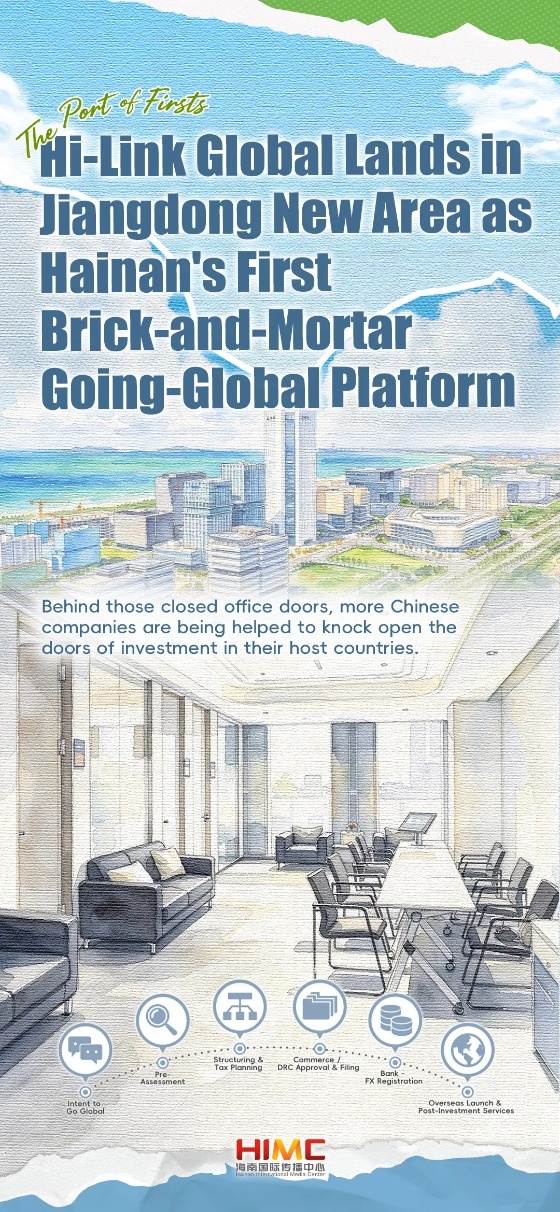
The platform's offices sit inside the Hainan Hongbao Investment Headquarters in Haikou’s Jiangdong New Area (JDNA). The tower’s soaring, brightly lit lobby grants access to the headquarters of a number of Chinese and global Fortune 500 companies. Ride the elevator up to the platform’s floor, and you are greeted, not by ticket dispensers and long rows of service counters, but by three offices with closed doors and, beside them, a semi-open lounge stocked with drinks, arranged more like a private banking suite than a government service hall.
Why should government services operate behind closed doors? It is a question many first-time visitors ask.
"Filings for ODI — outbound direct investment — touch upon a company’s core trade secrets," explains Xu Yijie, investment promotion director at the Haikou Jiangdong New Area Administration. "Where I’ve invested and how much I’ve put in — I don’t want that seen by others. The application materials typically contain a company’s budget; if a competitor saw that, they could probably work out the company’s next strategic move."
Unlike the standardized, solemn (and—in Hainan's heat—sticky and sweaty) atmosphere of conventional service centers, the platform's office layout draws on the practices of private banks and investment promotion agencies abroad — warmer and more intimate, so that companies feel secure enough to talk their problems through.
This "service center by stealth" is led by the Department of Commerce of Hainan Province (DOCOM) and operated by the Haikou JDNA Administration. Hi-Link Global was officially inaugurated on April 15, 2026, at the sixth China International Consumer Products Expo, becoming Hainan Province’s first brick-and-mortar cross-border integrated service platform for enterprises going global.
The three offices correspond to three types of service: general services, legal consultation, and preliminary ODI review by both development and reform and commerce authorities. Outbound direct investment is governed by an approval-and-filing regime — commonly called the "ODI filing" — which certifies that a Chinese company legally holds equity or assets overseas and marks a company’s first step toward going global in compliance. The development and reform authority examines the project; the commerce agency examines the investing entity. Only after obtaining the Overseas Investment Project Filing Notification and the Certificate of Overseas Investment can a company’s funds legally leave the Chinese mainland. In the past, companies had to shuttle between departments; here, the three "windows" sit side by side and review cases jointly — companies can "talk directly to, and actually see, the people who press the buttons." Both windows work to explicit deadlines: project inquiries at the fast-track window set up on the platform by the Hainan Provincial Development and Reform Commission receive a reply within three working days, and the DOCOM window likewise processes cases within a set time limit.
What companies save is not just time. The platform currently offers 15 kinds of free services — including policy interpretation, ODI filing guidance, cross-border tax planning and legal compliance advice — so companies pay nothing for upfront consultation. Twenty-seven market-based institutions, spanning law firms, banks, notaries and financial and tax consultancies, have also moved into the platform. For companies, this brings the upfront cost of going global tangibly down.
Xu himself once managed overseas investments in the Cayman Islands, Hong Kong and Singapore, so he knows first-hand how hard going global can be. In his view, expanding overseas amounts to starting a business all over again in a foreign country — a systemic undertaking. The ODI filing is only a very small node in that full life cycle. Small as it is, it is where trade secrets all coalesce.
But the real challenges lie beyond the filing. The platform sums up the problems companies face after going overseas into three categories. The first is legal: unfamiliarity with union systems or with local customs and cultural differences in the destination country can expose a company to arbitration or lawsuits. The second is commercial expansion: companies must consider whether local supply chains, logistics and warehousing can keep up, and whether to rapidly bring in overseas marketing. In addition, if the industrial policies or politics in the host country suddenly shift, companies must respond promptly. Any one of these can sink an overseas investment.
Services for enterprises going global are tailored: no two companies have identical needs, and the experience of service providers matters enormously. On a company’s first contact with the platform, front-line staff first screen out sensitive countries, sensitive regions and sensitive projects before charting a path. The platform’s review of filing materials is equally granular: every cent spent must be backed by corresponding supporting evidence.
The platform traces its origins to 2023, when a wave of Hainan companies began venturing overseas, and Jiangdong New Area started out with corporate services and ODI filing guidance. At first, companies came in simply asking how to do an ODI filing. Soon, the platform came to realize that what companies needed was not a single-point service but support across the whole life cycle. The provincial development and reform commission’s fast-track window was later established. By 2026, the platform had gradually welcomed a range of market-based companies and professional service institutions, becoming a "one-stop shop" covering the full going-global cycle, from pre-investment to mid- and post-investment.
Hainan Hotdai Tech Co., Ltd. officially moved onto the platform in May 2026. According to Wu Zefan, the company’s deputy general manager, enterprises conducting ODI filings in Hainan broadly fall into two categories. Those that already have a plan, have studied the Free Trade Port’s policies, and care about specifics such as country selection, fund compliance and local market access. Then there are those that basically come with a rough idea, with the platform helping them assess feasibility and close the information gap. In pacing, most companies advance in phases — only after a smooth first-phase trial do they gain the confidence to scale up a second phase.
The shift by one Guangdong-based packaging materials company left a deep impression on him. Over the past five years, the company had built overseas projects in the Middle East and Southeast Asia, with all ODI filings initiated from Guangdong. However, after doing the math on the "dual 15 percent" preferential tax policies and the corporate income tax exemption on income from new overseas direct investment offered by the Hainan Free Trade Port, it initiated two overseas projects from Hainan this year — and the company says its future global expansion projects may all be launched through Hainan.
Being "plugged in" overseas is another clear differentiator of the platform. It maintains communication channels with foreign governments, industrial parks and administrative agencies, and has reached cooperation frameworks with institutions at home and abroad, including the China Council for the Promotion of International Trade (CCPIT), the Hong Kong Trade Development Council (HKTDC) and Enterprise Singapore. Under an advisory committee memorandum of cooperation signed between Jiangdong New Area and Singapore’s CapitaLand, going-global services for enterprises have been listed among the priority areas of cooperation. After one country-specific event on Namibia, the other side took the initiative to recommend its own companies to visit Hainan — the capacity for "reverse linkage" has been gained by the platform.
How did Hainan’s first brick-and-mortar cross-border investment service platform end up in JDNA? In Xu’s analysis, companies based in the area have a strong appetite for overseas investment, with both the number and the quality of their overseas ventures reported as high; and the park’s research into the integrated industry cycle of "international investment + international trade" runs deep.
作者: HIMC
责任编辑: 商赢兮
南海网版权声明:以上内容由南海网原创生产,未经书面许可,任何单位及个人不得以任何方式或理由对上述内容的任何部分进行使用、复制、修改、抄录、传播或与其它产品捆绑使用、销售。如需转载,请与南海网联系授权,凡侵犯本公司版权等知识产权的,本公司必依法追究其法律责任。电子邮箱:nhwglzx@163.com.