











Wuzhishan Weekend Market Offers Mountain Cultural Treasures
HICN2026-10-12 17:02:20
At 9:00 a.m. on October 3, Wang Yue'e drove from Sanya to Wuzhishan with her mother, husband, and child. Having seen the Wuzhishan market in a video, she had long wanted to visit. The family had already been to several of Hainan’s coastal attractions and wanted a change of pace and scenery. This time, the plan was to take a deep breath of the fresh rainforest air, visit the mountain city of Wuzhishan, and check out the authentic local market Wang had seen online. The Wuzhishan market is usually only open on Saturdays, but to accommodate the influx of visitors during the National Day holiday, the market remained open for three consecutive days, from October 2 to 4.
The large market is located along the banks of the Nansheng River in Tongza Town. Merchants from across Hainan had loaded up their vehicles and set out before dawn to reach the venue. As dawn’s first light shot out from behind the mountain peaks, travelers from Sanya, Haikou, and other far-flung locations began to arrive. The market stalls featured local Wuzhishan products such as ‘Five-Foot Pork’ and Li Brocade alongside special products and handicrafts from all across Hainan. Both the sellers and the buyers agree that the market is well worth the trip! Wu Zheng of the Minzu Research Institute of Hainan Province noted in a related article that local residents make up around 60% of market visitors, travelers from neighboring cities and counties account for around 30%, and road-trippers from Hainan and other areas comprise roughly 10%.
From above, the Nansheng River can be seen flowing through the city, along with the large market located along Henan Road. The main market area covers around 500 meters, and features 575 stalls. During winter, the peak market season, the market often expands - reaching a size of up to three kilometers. There are four major market sections, each with different types of products. The Mountain Produce section features items such as Wuzhi peaches and mountain camellia oil. The Food section is where the foodies come to find local dishes such as Three Color Rice and Bamboo Tube Rice. The Cultural & Creative section is full of hand-crafted items such as Li Brocade bags, fragrant sachets, and woven bamboo & rattan objects, while the Relaxation area offers rainforest-style tea along with local fruit such as mangosteen and rambutan accompanied by Li folk song melodies. Stalls from other parts of Hainan offer a wide variety of tropical fruit, clothing, and roasted snacks.
eat habit. Sixty-eight year old Wang Caifu makes the trip up from Sanya almost every weekend to buy local veal, Five Foot Pork, and wild vegetables to prepare at home during the week. Ji Danping, a representative of the Wuzhishan Jiahe Catering and Hotel Company, which is charged with providing services for the market, arrived at 5:00 AM to conduct an inspection and set up for a livestream scheduled to begin at 6:30 AM. The two streaming accounts that she manages have a total of over 30,000 followers, with the highest view count for a single video exceeding 1.1 million. Zhu Yanbei, a university graduate who returned to her hometown in Fu'an Village, Tongza Town, to start a business, set up stalls along with other members of her cooperative and hosted livestreams at the market. During peak periods, they can sell dozens of Li brocade garments in a single day.
The Nansheng River Market hasn’t always been like this. In early days, the market lacked a central venue and didn’t have standardized stalls. Villagers would gather here and there to sell home-grown vegetables, livestock, and mountain produce, and most customers came from the local area.
Around 2019, thanks to policies that provided assistance and promoted rural revitalization, Wuzhishan began offering guidance to scattered local markets. Village officials went door-to-door to mobilize residents, encouraging farmers to bring their surplus agricultural produce into the city. Liu Zhu, the market manager and the Party Leadership Group Secretary and Director of the Wuzhishan City Supply and Marketing Cooperative, said that local residents were initially not very enthusiastic. Some were only willing to come to the market if round trip transportation was provided. Farmers worried that their produce wouldn’t sell, and weren’t used to centralized stall arrangements and management. Village officials, government department staff, and market administrators made repeated visits to fully explain the situation and provide on-site guidance. The market designated specific stalls and access aisles, and also mandated that all meat sold in the market undergo proper inspection and quarantine measures. Now, stalls are available to local village residents free of charge, and are allocated by lottery. Specific product types are assigned to corresponding market areas. These measures have transformed what was once an ad-hoc, disorganized market into a thriving, regularly held event that operates smoothly and provides a stable business environment.
As the market stabilized, the roles of the farmers began to change as well. Around 5 AM, Chen Fan, from Fanxiang Village in Tongza Town, parked beside his stall and began to set out the veal and Five Foot Pork he’d just brought over. He’s been a vendor here for quite some time, and has seen the market change from a small-scale exchange of mountain produce into a regular weekend market. He no longer sells only meat from his own livestock, but also sources products from other local farmers and partners with two village residents who can’t get away from home. During peak season, he often sells out before 10 AM. By the end of August, there had been a total of 39 events at the market in Wuzhishan this year, with local farmers participating nearly 17,800 times, generating sales figures of over 8.24 million yuan, a year-on-year increase of 23.62%.
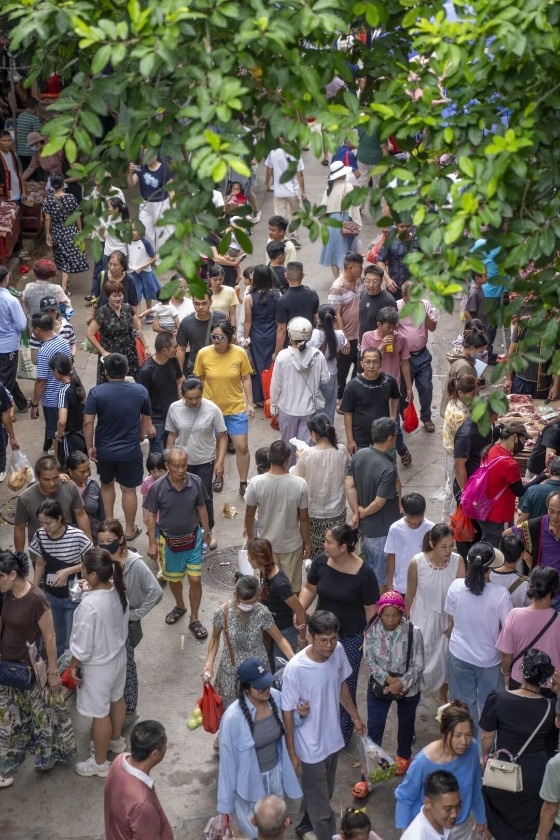
The Wuzhishan market was bustling on Aug. 8, 2026. (Photo: Li Tianping / Hainan Daily)
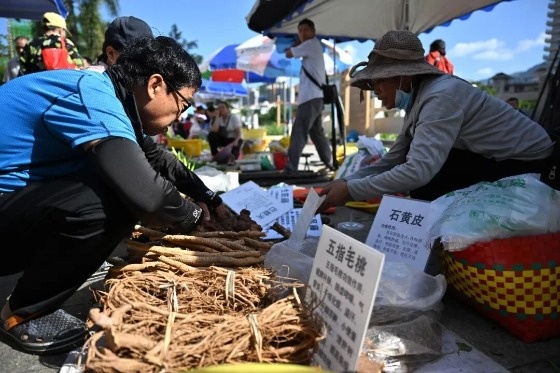
Market-goers purchase local specialties. (Photo: Guo Cheng / Xinhua)
As the number of out-of-town visitors increases, Wuzhishan is turning what was once a simple market visit lasting just a few hours into a full day or even two day long mountain city excursion. Whenever a major market day arrives, the freezers at Wuzhishan City’s Crystal Hotel work overtime. Beef, pork, and chicken purchased by guests at the local market are bagged and stored here temporarily, to be collected upon their return. Nearby, the Tongza 1988 Immersive Performance District transforms the historic government building complex into an evening sightseeing attraction. As night falls and vintage signs light up, a streetscape reminiscent of a supply and marketing cooperative of yesteryear comes to life. An immersive performance is also staged here, and Wu Xinhua, a retiree, sits with his spouse on the roadside steps to take in the show. The couple moved to Hainan after retiring. A friend recommended a special trip to Wuzhishan to visit the bustling local market and see the performance. Wu noted that the day was packed, including both a daytime visit to the market and an evening entertainment excursion. The typical travel route promoted by Wuzhishan involves browsing the market for local mountain produce and enjoying evening shows or a night cruise on the Nansheng River, followed the next day by visits to the Shuiman Township tea plantations, Yahu Terraced Rice Paddies, or the scenic rainforest area.
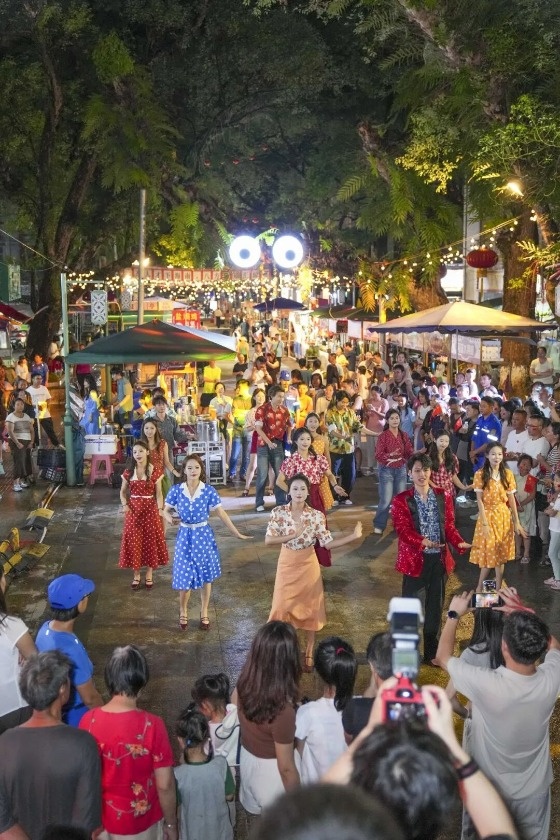
A performance at the Tongza 1988 immersive street district in Wuzhishan City on Oct. 3. (Photo: Li Tianping / Hainan Daily)
The rise in visitor numbers has also brought new challenges. The large-scale market requires cooperation across multiple departments in organization, coordination, on-site management, and promotion. The market's long-term vitality will depend on the enthusiasm of vendors and more sustainable, market-oriented operational models. There’s also room to further raise the value of these mountain products. Some visitors and industry insiders note that many of the items currently sold at the markets remain primarily raw agricultural products. The market already enjoys a solid reputation, and now he next steps will involve further refining quality standards, product processing, packaging design, and supply chain development. Once the market draws visitors in, Wuzhishan plans to offer more compelling attractions to encourage them to stay longer. Only through continuing to update the historic town entertainment, intangible cultural heritage experiences, and countryside travel products can weekend visitor numbers be converted into relatively stable consumer spending on accommodation, dining, and tourism activities.
Around noon on Oct. 3, the stalls along the Nansheng River began to prepare to close for the day. Wang Yue’e and her family were already carrying bags full of items: ‘Ant Chicken’, wild honey, fresh beef, and Lingzhi mushrooms. Meanwhile, her child had picked out a small, handmade Li brocade hanging ornament. Wang noted that these were all high-quality local mountain products. The Li Brocade ornaments, with their distinctive folk art vibe, make perfect gifts for friends and family. As the afternoon progressed, vehicle after vehicle filled with happy travelers and laden with locally purchased products began to depart from the banks of the Wuzhishan River, carrying mountain treasures throughout the island and across the sea.



海南国际传播中心出品
Hainan International Media Center Presents

Translator: Nicki Johnson
翻译:谢敏(美国)

作者: Nicki Johnson
责任编辑: 李想
南海网版权声明:以上内容由南海网原创生产,未经书面许可,任何单位及个人不得以任何方式或理由对上述内容的任何部分进行使用、复制、修改、抄录、传播或与其它产品捆绑使用、销售。如需转载,请与南海网联系授权,凡侵犯本公司版权等知识产权的,本公司必依法追究其法律责任。电子邮箱:nhwglzx@163.com.