











A New “Wild Run” in the Rice Waves
HIMC2026-10-09 16:15:00
Editor's Note
The 2026 National Day holiday is the first National Day Golden Week since the Hainan Free Trade Port commenced its island-wide special customs operations. Starting today, Hainan Daily launches the column "Hainan Tourism's New 'IN' Vibe." With "new" at its core, the column focuses on new scenes, new experiences, and new groups of visitors; with "IN" as the benchmark, it highlights trend appeal, experiential engagement, and social shareability. Through concrete examples, it presents Hainan‘s cultural tourism upgrading from sightseeing-oriented to experience-oriented, showcasing new vitality in tourism consumption and new momentum for industry development.
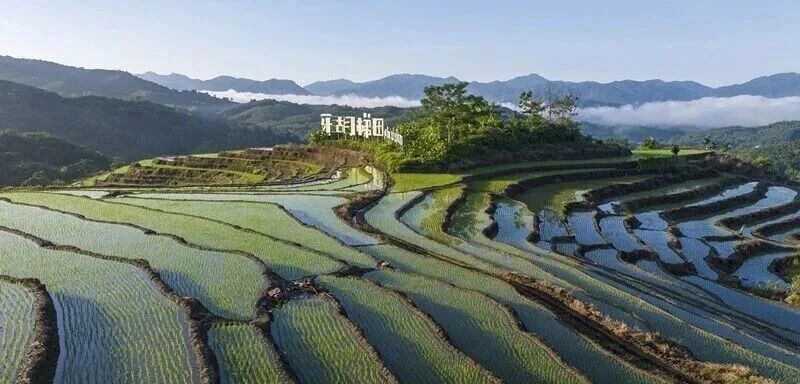
At 3:30 p.m. on October 1, the starting gun fired, and more than 600 tourists surged toward the higher reaches of the Yahu Terraces. A flag-seizing and flag-planting cross-country race was underway. Terraces unfolded tier upon tier along the mountain slopes; looking upward, waves of rice stretched all the way to the clouds.
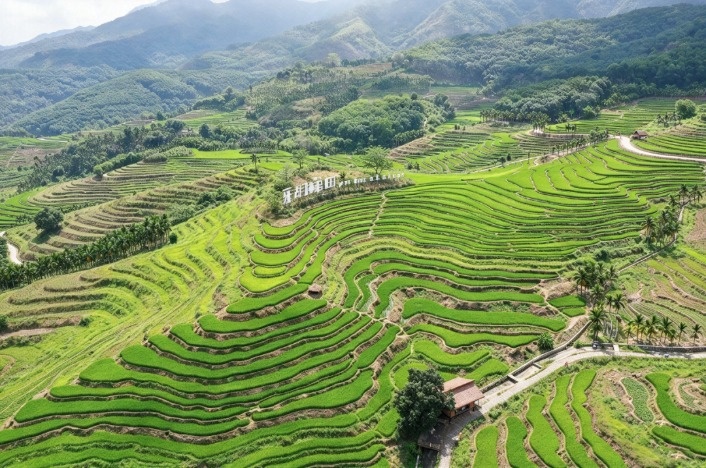
The Yahu Terraces are located in Yahu Village, Maoyang Town, Wuzhishan City, with Yinggeling at their back. They are Hainan's largest and most representative mountain terraces and are known as "Hainan's No. 1 Terraces." During the National Day holiday, Maoyang Town, drawing on Qiongya revolutionary heritage and Yahu Terraces cultural tourism resources, held the flag-seizing and flag-planting cross-country race to promote rural cultural tourism and burnish Maoyang's "red heritage + pastoral" cultural tourism calling card.
Lin Xiaoyu from Haikou and her 8-year-old son were among the crowd. The child clutched a small national flag and ran forward tirelessly, his face flushed. Lin chased after him as best she could. "Slow down! Don't fall."
Chasing each other, the two reached the first challenge: a flag-winning quiz on the terrace viewing platform. "When was the People's Republic of China founded?" Before the volunteer could finish, the child answered, "1949."
Taking a large national flag, he raised the pole above his head and dashed into the waves of rice. Looking in the direction where her son had disappeared, smile lines crinkled at the corners of Lin's eyes. "I only wanted to bring him out for some exercise. I never expected to see such beautiful scenery. It was well worth the trip."
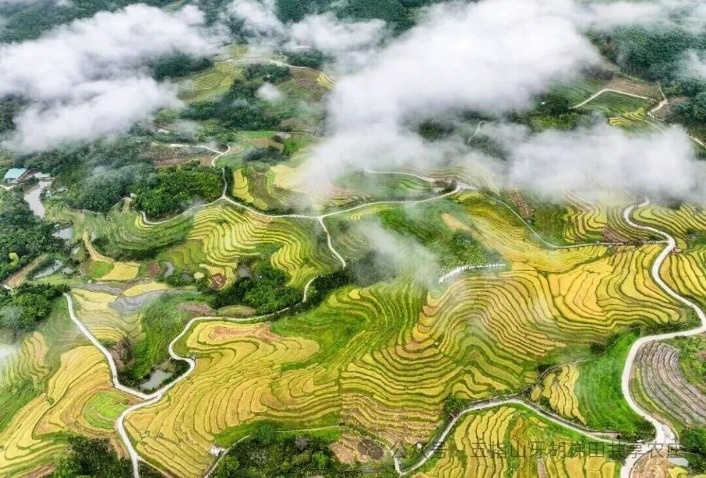
Beyond the bustle of the race was a quieter scene. Deep in the terraces, many visitors were in no hurry to cross the finish line, instead strolling leisurely along the field ridges.
Wang Huimei, a retired teacher from Beijing, was visiting Wuzhishan for the first time and "hid away" in a coffee shop beside the rice fields. "After this run, I plan to stay in the mountains for a few days—listen to the roosters, look at the stars, and breathe the fresh mountain air."
In the distance, a young mother was holding up her phone to photograph her child standing on a field ridge. The rice waves and the child's smiling face were captured together in the frame.
At supply stations along the route, Li-style specialties such as Wuzhishan five-foot pork, Wuzhishan wild vegetables, and Maoyang sweet potatoes were laid out in a row. A sweaty runner grabbed a sweet potato and said while munching, "This is really hearty race fuel. The sweet potato is sweet and glutinous—the more you chew, the better it tastes."
Back at the starting point—the plaza at the Maoyang Entrance Service Base of Hainan Tropical Rainforest National Park—Li performers clapped bamboo poles. As the poles opened and closed, runners jumped and landed to the rhythm; the nimble ones cleared several rounds in a row.
A middle-aged woman who had completed the course jumped into the bamboo dance formation again. She danced three rounds before coming out and wiping her sweat. "Running is exercise, and the bamboo dance is exercise too."
As the sun slanted westward, runners arrived at the finish one after another. In the center of the plaza, long white stone steps rose tier upon tier. Participants carefully fixed the five-star red flags in their hands to the railings on both sides of the steps. Flag after flag spread upward, extending along the steps toward the giant red flag sculpture at the top.
Wang Yonghui, Party secretary of Yahu Village, said that since the Yahu Terraces agritourism integration project began operation, the village had recorded cumulative comprehensive tourism revenue of about 11.74 million yuan and collective income of 8.21 million yuan, attracting more than 203,000 visits.
Wu Kaishuai, Party secretary of Maoyang Town, said: "The terraces should not only let visitors see the scenery, but also let them step into it. The flag quiz, bamboo dance, and Li delicacies—each and every one—turn ethnic culture into tangible, sensory experiences, making the mountains' fine scenery, fresh air, and premium local produce a visible 'bountiful scene' of culture and tourism."
This holiday event hidden in the rice waves is a perfect illustration of the harmony between motion and stillness—when running, one enjoys the exhilaration of sport; when strolling, one takes in the beauty of the terraces. In Wuzhishan, visitors can get active and release their energy, or slow down and savor the everyday life and scenery of the mountain countryside.
As the setting sun sank behind the silhouette of Wuzhishan, the rice in the terraces and the red flags across the hills still swayed in the evening breeze.
作者: Weng Di
责任编辑: 翁翟